[ close ]
Help Upgrade the Web: Download Firefox 3.6

Archive for Digital Media Relations

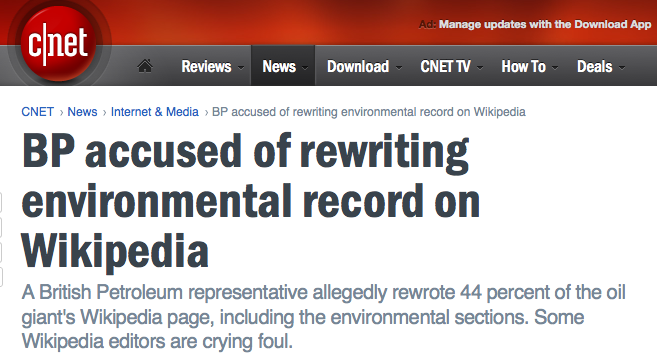
Reputation and Wikipedia

// January 6th, 2012 // 8 Comments » // Communities/Social Networks, Digital Media Relations, Public Relations

[Originally written for the CIPR Friday Roundup]

What does the Wikipedia entry for your organisation / client / brand say? What about brand references in other entries? All cosy on the Wikipedia front? And recognising that a neutral point of view (NPOV) is one of Wikipedia's "five pillars", you have resisted editing anything where your neutrality is questionable. Right?

Let's face it, Wikipedia is amazing. I had the pleasure of attending the Wikipedia 10th birthday party in London last year and I wasn't the only one there who admitted to not appreciating Wikipedia's potential back in the day. Seriously? A website anyone can edit?! Yeah right, that'll work. Not.

And yet today Alexa ranks Wikipedia the sixth most popular site on the web. Search for a company or brand in Google or Bing and there's the Wikipedia entry tempting you with its neutrality, familiarity and ease of use. The Wikipedia community plays a significant role in brand reputation.

This week, one of my favourite Conversation contributors, Stuart Bruce, spotted Member of Parliament Tom Watson's interest in Wikipedia and PR practice. He found Watson's contribution, Wednesday, to a Wikipedia talk page: (more...)

The Influence View of Content – seeking something more useful than ‘paid, owned, earned’

// November 14th, 2011 // 6 Comments » // Digital Media Marketing, Digital Media Relations, Public Relations, Website/New Media

[Version 0.1 << work in progress needing your critical feedback. Also available as a PDF if that suits you better.]

Précis

Categorising media as Paid, Owned and Earned isn’t particularly useful. In fact, it simply appears to reinforce increasingly irrelevant functional silos.

The Influence View of Content aims to establish something more useful. It’s a perspective that seeks to help influence professionals think about how influence goes around and comes around in line with the Influence Scorecard framework.

Definition: Influence – you have been influenced when you think something you wouldn’t otherwise have thought or do something you wouldn’t otherwise have done.

Definition: The Influence Scorecard – serves as both the methodology for defining influence strategy and the tool for executing it.

Paid Owned Earned

With the proliferation of what used to be known as “new media”, it was natural to attempt some sort of descriptive taxonomy: (more...)

Measuring Online – CIPR Freshly Squeezed training session

// October 25th, 2011 // No Comments » // Digital Media Marketing, Digital Media Relations, Measurement & Analysis

An interesting start to the day today... over to CIPR HQ in Russell Square to deliver a training course on social measurement in the Freshly Squeezed series.

I had just 45 minutes with 15 minutes Q&A, and this time constraint combined with the state of best practice in the profession meant I was aiming simply to leave attendees knowing the right questions if not the right answers per se. After all, as the slidestack below teases out, if your organisation, marketplace, stakeholders, marketing and PR objectives, marketing and PR strategy and execution are unique, it shouldn't come as too much of a surprise that your metrics will be unique too.

I can't tell you what they are (well, without being retained by you anyway!)

Thanks to Andrew Bruce Smith (@andismit) for being in the chair, and for Andrew Ross (@AJMRoss) for putting the session together.

Guilty – The CIPR Friday Roundup

// July 1st, 2011 // No Comments » // Digital Media Relations, Public Relations

We have a fundamental tenet in our Western societies – innocent until proven guilty. The problem we have now is simply that reputation pivots faster via the social Web than can be adjudged in the courtroom.

I have no idea whatsoever whether Dominique Strauss-Kahn did or did not rape or sexually molest the hotel maid. But he has already lost his job heading up the International Monetary Fund. His chances to run for senior government office are dashed. If he's found guilty, then you might say all's well and good, but he is currently innocent until proven guilty, and may never be found guilty. Charges may even be dropped. Where's the "all's well and good" in that?

This trend is significant for reputation management – of organisations as well as individuals.

And yet given the radical and real-time transparency of the social Web, I've been saying recently that 'reality is perception'. I posit that this is a more relevant axiom today than the one that dominated the 20th Century, 'perception is reality'. Am I not, therefore, contradicted here? (more...)

Social media measurement and the Influence Scorecard – HWZ Social Media Conference

// June 30th, 2011 // 2 Comments » // Digital Media Marketing, Digital Media Relations, Measurement & Analysis

I've just arrived in Zurich at HWZ (Zurich University of Applied Sciences in Business Administration) for today's Social Media Conference. I'm delighted to be keynoting at 1.30pm, and here's my presentation.

I know... it's a bit text heavy in parts. @gabbicahane has already pointed that out to me. I protested that for a slidestack to make sense to those people who are interested but who cannot make the conference, it needs to have more context than some beautiful pictures and seven words per slide.

Always ready with a smart answer, he suggests I have two stacks in future... one for the presentation, one for slideshare.

Is there an app for that?

How data is transforming digital marketing

// June 29th, 2011 // No Comments » // Digital Media Marketing, Digital Media Relations, Measurement & Analysis, Technology, Website/New Media

Digital marketing has come a long way in the past decade, as we’ve moved beyond putting existing materials online and learned how to really harness the native advantages of digital technologies.

The pace of change continues unabated, and among its most important drivers is data – and the meaning of that data.

Every one of us is going to be producing more data describing our use of digital products and services. This is what I like to call digital detritus. Detritus – discarded organic matter which is decomposed by microorganisms and reappropriated by animal and plant life – is interestingly analogous to our regard for, and treatment of, the data that we’re all shedding.

Big data

When it comes to the increase in data, we’re working on a logarithmic scale: we’re talking about hundreds and thousands of times more. Data in such quantities may well prove to have important new mathematical properties that are attractive to marketers, customer service and product development teams. Moreover, we don’t actually do much with the digital detritus today – it mostly resides in inaccessible log files, although the technology for collating it is becoming increasingly achievable and affordable.

What does this mean in everyday terms? (more...)

My book, The Business of Influence, is out today

// April 15th, 2011 // 1 Comment » // Communities/Social Networks, Digital Media Marketing, Digital Media Relations, Measurement & Analysis, Public Relations, Technology, Website/New Media

Today's the day!

The Business of Influence: Reframing Marketing and PR for the Digital Age

The Business of Influence: Reframing Marketing and PR for the Digital Age

It's ready for delivery in the UK today, and pre-order in other parts of the world. For those of you tweeting about availability in the US, currently listed as mid-June by some bookstores, Wiley tells me it should actually be with you mid-May. Thank you for your interest and patience.

What's it about?

The Business of Influence is a rethink.

It's about improving the capabilities of organisations to design and attend to the way in which all aspects of its operations influence stakeholders, about making sure stakeholders influence it, systematically, and about how well competitors are attempting the same. It focuses on influence as the common denominator of marketing and public relations and related activities such as customer service, sales, product development and HR, and therefore the basis for redesigning these and interconnecting them.

The book introduces the Influence Scorecard, named in homage to the dominant framework for business performance management, the Balanced Scorecard. The Influence Scorecard then is a subset or view of the Balanced Scorecard containing all the influence-related key performance indicators (KPIs) stripped of functional silo, and it may extend beyond the Balanced Scorecard should a greater operational granularity of metrics be demanded by the influence strategy.

The Influence Scorecard is a new framework for the 21st-century designed to help organisations focus on what matters rather than continue to carry the baggage and inefficiencies that come part and parcel of the typical 20th-century marketing and PR structure and approach. It's a reframing in the context of 21st-century media and disintermediation, 21st-century technology, and 21st-century articulation of and appreciation for business strategy. (more...)

Radian6 and the Insights Platform – getting semantic

// April 7th, 2011 // 3 Comments » // Communities/Social Networks, Content, Digital Media Relations, Public Relations

Radian6 Social2011 conferenceI'm in Boston this week for the Radian6 Social 2011 Conference. (Disclosure: Radian6 is paying my expenses to be here.) So far I've enjoyed talking with Radian6 CMO David Alston, OpenAmplify CEO Mark Redgrave, Edelman's David Armano, Dell's Head of Interactive Marketing Adam Brown, Klout Head of Platform Matthew Thomson, Marshall Sponder and Nathan Gilliatt.

Radian6 CEO Marcel LeBrun has kicked off the event this morning by launching the new Insights Platform, and I appreciate why Marcel is so enthusiastic about it.

Here's how Radian6 describes it:

Insights are answers. Insights give meaning to unstructured volumes of content based your needs and integrated into our current dashboard offering. Current partners include Klout, OpenAmplify and OpenCalais. The insights that each of these partners offer (like age range, location, influencer score, textual analysis) are added as drill down options on the Dashboard widgets, so you are able to take your Radian6 topic profile mentions and overlay the insight partner data all in one place. No exporting River of News and doing comparative analysis in Excel to these providers data from your separate account, now it’s all been brought together for you.

How does it work? Well Radian6 has leaned heavily on the three partners, with both OpenAmplify and OpenCalais having deep expertise in semantic technologies. This is the tech that helps interpret, understand and process the meaning of content. Serious stuff. (more...)

CIPR social media measurement guidance

// March 29th, 2011 // No Comments » // Communities/Social Networks, Digital Media Relations, Measurement & Analysis

CIPR social media measurement guidelinesThe AVE (advertising value equivalence) approach to PR measurement and evaluation was simple. And utterly wrong.

It’s a specious sum based on false assumptions using an unfounded multiplier and only addressing a fraction of the PR domain – a greater waste of time and effort you couldn’t hope to find.

Measurement and evaluation is essential, but requires real strategic understanding, diligence and perseverance. For me, it represents yet another distinction between the 21st Century PR professional and the 20th Century practitioner.

The CIPR launches its guidance on social media measurement today. As chair of the CIPR's social media measurement group, I'm particularly keen to learn what you think. I'm afraid it is no silver bullet, and that's simply because there will never be a silver bullet.

Here are the links:

To the social media measurement guidance page on the CIPR's website.

To the guidance PDF directly.

What’s the ROI of social media?

// March 17th, 2011 // 8 Comments » // Communities/Social Networks, Digital Media Relations

I was delighted to have the opportunity to present my take on the ROI of social media to approximately 80 people yesterday evening at the Digital Publishing Forum. It seems this was a hot topic of interest; as well it should be.

I sought to put the topic into perspective with the following challenge. What's the ROI?...

  • Of the latest rebrand?
  • Of the office refurb?
  • Of the internal communications activity?
  • Of the training and development programme?
  • Of the upgrade to Windows 7?
  • Of the new standard issue smartphones?
  • Of the stakeholder engagement via social media?

If you'd like to see where we went from there, here's the presentation:

Thanks to Julia Lampam (@JuliaLampam) for the invitation to speak.